



B2C vs D2C: Choosing the Right Model for Your Business
Confused between B2C and D2C? Learn the key differences, pros, and cons of each model—and how to align sourcing strategies to grow your business smarter.
200+ buyers trust Torg for sourcing





Whether you’re launching a product or not, how you sell it is just as important as what you’re selling. That’s where B2C and D2C come in.
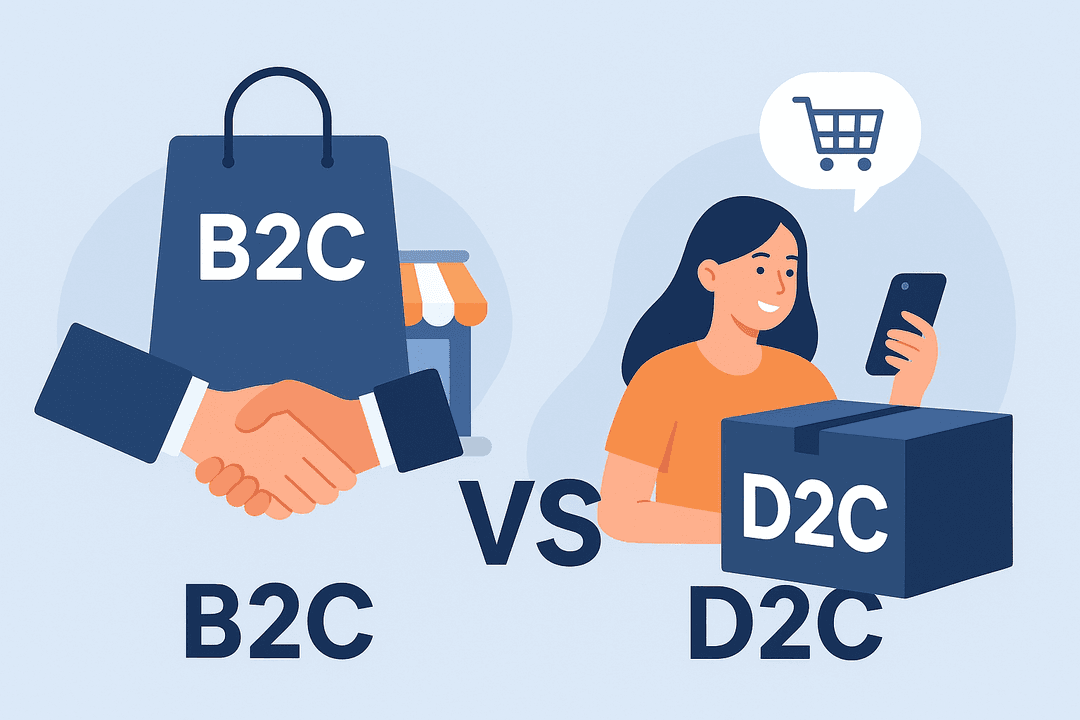
B2C means selling through big retailers, third-party sites, or distributors. Think supermarket shelves, department stores, and Amazon pages. You get reach and convenience but lose some control. D2C is the opposite. You do everything yourself, from the site to shipping to post sale support. It’s more work but you own the brand on your terms.
This guide is for brand owners, product founders, and marketers deciding which business model fits best. We’ll break down the pros and cons of each, from how they impact customer relationships to how they shape your profit margins, marketing strategies, and control over the supply chain.
What Is B2C?
B2C, or business-to-consumer, is a business model where companies sell products or services directly to individual customers rather than to other businesses. Instead of always selling through their own channels, businesses often use retailers, online marketplaces, and eCommerce platforms to reach a larger audience.
This model focuses on scale, convenience, and exposure rather than complete control over the sales process. Companies invest in creating products that appeal to consumers, while partners and distributors handle logistics, storefronts, customer service, and delivery.
B2C is especially popular in industries like fashion, electronics, home goods, and consumer services, where high sales volume and brand visibility matter more than maintaining a direct, long-term relationship with each customer.
Key Characteristics of B2C
B2C companies typically depend on established sales channels such as supermarkets, retail chains, or online behemoths such as Amazon. The customer relationship isn't owned by the company; the retailer owns it. Most of the marketing pushes out to a mass audience, and personalization is low. The customer's buying process is shorter and transaction-oriented. You don't have to own your own online store or warehouse, but you also sacrifice the potential for gathering valuable data, more customer insights, or providing customized experiences and customer satisfaction.
Pros of B2C
- More reach, quicker sales
- Smaller upfront costs
- Built-in trust
Cons of B2C
- Narrow profit margins
- No control over customer experience
- Limited access to customer data
What Is D2C?
D2C, or direct-to-consumer, is a business model where brands sell products directly to customers without relying on third-party retailers, wholesalers, or online marketplaces. Instead of sharing profits with middlemen, D2C companies use their own websites, branded online stores, and eCommerce platforms to manage the entire sales process.
This model gives brands full control over the customer journey—from marketing and online checkout to shipping, customer support, and post-purchase engagement. By owning every touchpoint, D2C businesses can build stronger customer relationships, gather valuable data, and maintain higher profit margins.
Key Characteristics of D2C
You have full control over how you operate and communicate. You’re the owner of the sales cycle. You decide how the site looks, how the customer journey unfolds, and how you collect valuable customer insights. You’re also the first to know when there are customers complaints which gives you the opportunity to fix issues quickly and make your customers happy.
And here's the best part: you gather all the data points. Every click, every buy, every preference, those are your insights, not a retailer's. That type of customer information is gold if you know what to do with it.
You also control your brand identity. No adjacent placement next to competitors on a cluttered shelf. No diluted messaging to fit into someone else's marketing mold. Just your brand, your voice, your rules.
Pros of D2C
- Total control over brand and customer experience
- Access to deep customer insights
- Higher profit margins
Cons of D2C
- Higher overhead costs
- More complex business operations
- Heavy reliance on digital marketing
Key Differences Between D2C and B2C
Deciding between D2C and B2C is not a logistical one, it determines how your whole business works, makes money, and resonates with individuals.
Control Over the Whole Process
A D2C model provides you with total autonomy. You own your online storefronts, control the sales process, and do everything from product creation to customer service. That translates to having control over prices, brand message, customer experience, and even return policies. With B2C, however, there is a strong dependence on third-party online retailers or established distribution channels. The moment your product reaches someone else's shelf (or website), you have no control over its presentation or promotion.
Customer Relationships and Insights
D2C businesses establish a direct connection to the buyers. Every touchpoint such as browsing history, complaints by customers, repeat orders are fed into a rich data set. You have more insights about customers, more power to control communications, and better knowledge of customer choice. B2C businesses, on the other hand, sell products via intermediaries and seldom get that level of valuable customer data. You are at the mercy of whatever insights those channels are privy to, if any.
Margin vs. Reach
D2C models tend to have higher profit margins. Why? No intermediaries. You sell direct to the end consumer, so you retain more of the revenue. But it involves greater overhead expenses such as warehousing, digital marketing, fulfillment, and hosting your own ecommerce site. B2C, on the other hand, gives up margin for reach. You ride on existing retail channels and leverage their vast customer base but give up a large cut to them.
Data, Brand Identity, and Flexibility
Selling through a D2C model allows you to collect rich customer data that is used to enhance products, execute targeted marketing efforts, and make more informed decisions. You also get to tweak your brand to have a stronger brand identity. You're not constrained by shelf real estate or third-party policy. In B2C, you're generally restricted as to how your brand is presented and marketed. You also lose the direct feedback loop, which hampers your ability to respond quickly.
🚀 D2C gives you control. B2C gives you reach. Whichever path you choose, sourcing smart is essential. Torg is a business-to-business model platform that helps you find the right suppliers to support your model. Sign up and access verified, responsive partners who scale with your goals.
Request a Bulk Order Quote
Simple ordering, transparent pricing, delivered straight to your door
When to Choose B2C or D2C?
Before you choose a sales model, you might ask yourself: What type of business are you actually trying to create? Your product, budget, audience and growth strategy all come into play. There’s no one size fits all, only what works for you. Here’s how to narrow it down.
Type of Product
If you're selling commodity products such as toiletries, snacks, or cleaning products, B2C is the way to go. These are designed for volumes and visibility. Big-box retail shelves and well-known platforms do all the heavy lifting. But if your product is niche, high-touch, bespoke, or lifestyle-driven (such as wellness kits, designer clothing, or subscription boxes), D2C provides room for you to build a brand story, inform customers, and foster deeper brand loyalty.
Brand Maturity
If you already have traction in retail and you're already established, B2C expansion can happen rapidly with low friction. Customers trust known brands. However, if you're a new brand wanting to make an announcement or dictate how the world comes to learn of you for the first time, D2C allows you to have that control. It's your packaging, your narrative, your price without retail buyers or shelf space politics getting in the way.
Budget and Logistics
Let's discuss resources. B2C is less intense initially. You pass off fulfillment, logistics, and sometimes even marketing to the retailers. It's plug-and-play, but without as much control. D2C takes more cash and infrastructure. You'll have to invest in your ecommerce platform, warehousing, customer support, and last-mile delivery. The bonus? You retain more of the revenue and data collection.
Target Audience Preferences
Your customer's behavior must inform your decision. If they love quick, convenient buys in store or online that they're already accustomed to shopping at, B2C facilitates this. However, if they desire novel experiences, personalization, or continuous customer interaction (such as carefully curated bundles or loyalty programs), D2C is where you can excel. It enables closer feedback loops and more customized advertising.
Marketing Differences Between B2C and D2C
Marketing in a B2C format is playing by someone else's rules. Your product hinges on shelf space, promotions from the retailers, and if the store employees bother to restock. You're in a lineup, not in the headlining act. You can do brand awareness campaigns, of course, but when it comes to customer information or direct impact, you're mostly in the dark.
D2C flips that completely. You own the sale, the story, and the traffic. You control what people see, when they see it, and how you follow up. It's harder work so you need a full funnel plan, great digital footprints, and keen customer acquisition chops. But the reward? More control, better insights, and the ability to build brand equity without some watered-down message. You’re not renting space on someone else’s shelf, you’re building your own.
Technology Stack and Tools for Each Model
The tech you select is based on whom you're selling to and how intimately you want to be with your customer.
If you're operating a D2C company, you require a full-stack infrastructure that provides you with control right from the initial click to the last delivery. Your tools drive the entire customer experience, so they can't be slow and disconnected.
D2C Tech Essentials:
- Ecommerce store: Shopify, WooCommerce, or BigCommerce to host your storefront
- Analytics: Google Analytics, Hotjar, and post-purchase surveys to monitor behavior and optimize UX
- Email and SMS marketing: Klaviyo, Mailchimp, Postscript for automating messaging and building loyalty
- CRM & personalization: HubSpot or Omnisend to segment and personalize
- Checkout & payments: Stripe, PayPal, and one-click checkout tools to minimize cart abandonment
- Fulfillment stack: ShipStation, Easyship, or custom integrations to deliver quickly and accurately
If you’re going the B2C route (through retailers or third-party sellers), the focus shifts. You’re not managing customer relationships directly, you’re making sure your operations sync well with your retail partners and distributors.
B2C Tech Focus:
- Retail sales tracking: NielsenIQ, SPINS, or POS data from partners to monitor performance
- ERP systems: NetSuite, SAP, or Odoo to handle large-scale inventory, logistics, and invoicing
- Channel integration tools: EDI platforms such as SPS Commerce or Logicbroker to allow clean data exchange between you and retailers
- Marketing analytics: Brandwatch or Sprinklr to monitor what’s being said and where, as feedback is not coming directly to you
In short: D2C is complete control but more moving parts. B2C is less complicated on the customer side but requires close-up operations behind the scenes. Select tech that works for how you sell.
Customer Experience: Who Owns the Relationship?
This is where B2C and D2C entirely diverge.
In D2C, you control every touchpoint. You get to know what your customer browsed, purchased, or bounced away from. You dictate the messaging, the tone, and the follow-up. That information? It's gold. You can personalize each step such as send a restock alert, provide exclusive bundles, or recover a cart in minutes. You're not merely selling a product; you're crafting the experience about your brand.
In B2C, the retailer owns the relationship, not you. The customer might love your product but their loyalty sticks with Amazon, Walmart, or whoever sold it. You’re boxed in. No customer emails, no behavior data, no second chances if they walk away. Your influence starts and ends with the product on the shelf including packaging, pricing, and a few fleeting seconds of attention.
If you're serious about long-term brand equity and loyal customer base, D2C puts you directly in touch with it. With B2C, you're leaving it in someone else's hands to carry your message and hope for the best that it doesn't get lost.
D2C vs B2C Profit Margins and Revenue Potential
Now, completely transparently, D2C may have more profit per unit, but it's not a free ride.
When you sell direct-to-consumer, you retain more of the sale. There is no wholesale discount, no retail markup, no commission to nibble away at your profits. But that margin has a price tag. You're paying for ads, for tech, customer service, fulfillment, and retention efforts. If your CAC (customer acquisition cost) increases or repeat orders decline, your margins get squeezed quickly.
B2C, conversely, is volume-driven. You sell less per transaction, but big-box stores or online marketplaces can shift significant volume. They've already got traffic, trust, and distribution lined up. That translates to fewer overhead headaches on your part—but less pricing and branding control.
In plain terms:
- D2C provides you margin control, customer insights, and adaptability. But it requires investment.
- B2C offers reach and stability. But you're trading off profit per unit and retaining less of the relationship.
Neither is better all around. It just depends on your cash flow, objectives, and how much you want to handle yourself.
Growth Strategies for B2C and D2C Business Models
B2C growth is driven by distribution, not just demand. You’re scaling by getting your product into more stores, more aisles, more locations. That means you’re building relationships with retail buyers, attending trade expos, and fighting for shelf space. Your packaging does the selling; your volume keeps you alive. Margin might be thin, but the reach is wide.
D2C is a different game. It’s digital-first and retention-obsessed. You grow by capturing attention online, converting it, and keeping those customers coming back. Think Meta ads, TikTok content, email flows, reviews, loyalty programs. SEO helps. So do influencers. But it’s your ability to create emotional connection (and deliver consistently) that fuels long-term scale.
Here’s the tradeoff:
- B2C = external gatekeepers, high volume, slower feedback.
- D2C = more control, faster iteration, higher risk and reward.
Pick your lane or blend both if your team can handle it.
Emerging Trends in B2C and D2C
The boundaries of B2C and D2C are blurring rapidly. What was once a binary distinction (retail shelves vs. owned online stores) has become a mash-up of numerous channels, data strategies, and customer touchpoints. Brands are no longer choosing one lane. They're creating smarter, layered models to reach people where they shop.
Rise of Omnichannel D2C
D2C brands aren't living in their ecommerce bubble. They're appearing in the physical world such as pop-up stores, retail collaborations, and even flagship stores. Why? Because having total control over the customer experience and increasing reach is a win-win. This hybrid D2C model combines control with exposure.
D2C Brands Venturing into Retail
D2C isn't anti-retail. It's just reimagining how to get in. Glossier and Allbirds began as direct-to-consumer businesses, they developed superfans, and now leverage that to secure retail partnerships. They come in with brand equity, not cold pitches and that earns shelf space without sacrificing their direct-to-consumer DNA.
Hybrid Models
The wisest brands don't have a single model. They sell online on their platform, through online marketplaces like Amazon, and secure wholesale deals with retail chains. It's not either D2C or B2C. It's about having a nimble, multi-channel configuration. When one stream slows, the others keep revenues coming. That's true stability.
Social Commerce and Live Shopping
D2C brands are no longer merely place-running ads. They're making TikTok and Instagram full-blown sales machines. Live shop events, live demos, and click-to-buy posts translate engagement into real-time conversion. It's quick, interactive, and crazy effective at building brand warmth and securing first-party data.
Conclusion
The B2C or D2C decision is both a strategy and a structure. B2C provides you with reach via retail partners, but you are out of control and lose customer data. D2C places the reins in your hands like increased margins, greater insights, but it requires a more robust team, technology, and brand narrative to make it successful.
Choose based on what you can sustain, not what sounds better. If you're a new startup, D2C can drive you to act quickly and learn in real-time. If you're scaling up, B2C can release volume. Most brands blend both. The key is to understand how each model influences your sales, your margin, and your relationship with the customer.
Frequently Asked Questions
1. What is the difference between B2C and D2C?
B2C is selling via a middleman such as Target, Amazon, or any third-party store. D2C is selling directly to the customer, typically through your own website or app. You control the brand, the experience, and the customer data from beginning to end.
2. Is Amazon B2C or D2C?
Amazon is a B2C site. It sells to individuals, as a retailer. Some brands sell D2C-style on Amazon through branded shops, but Amazon itself is always still the intermediary.
3. Can a company be both B2C and D2C?
Yes. Many brands operate hybrid models, selling direct to consumers (D2C) while also loading shelves at retailers or listing in marketplaces (B2C). It's a savvy approach to diversify risk and increase reach.
4. Which is more profitable, D2C or B2C?
D2C tends to have more margin because there's no middleman skimming it. But you get more expenses like marketing, shipping, and support. The margins on B2C are thinner, but you get more scale and less day-to-day operations.
5. What is the future of direct to consumer brands?
D2C brands are changing rapidly. Get used to seeing more brands appear in both online and offline stores, embracing social selling, tap data to provide a customized buying experience. The winners will be those that best understand their customers and tap into flexibility.